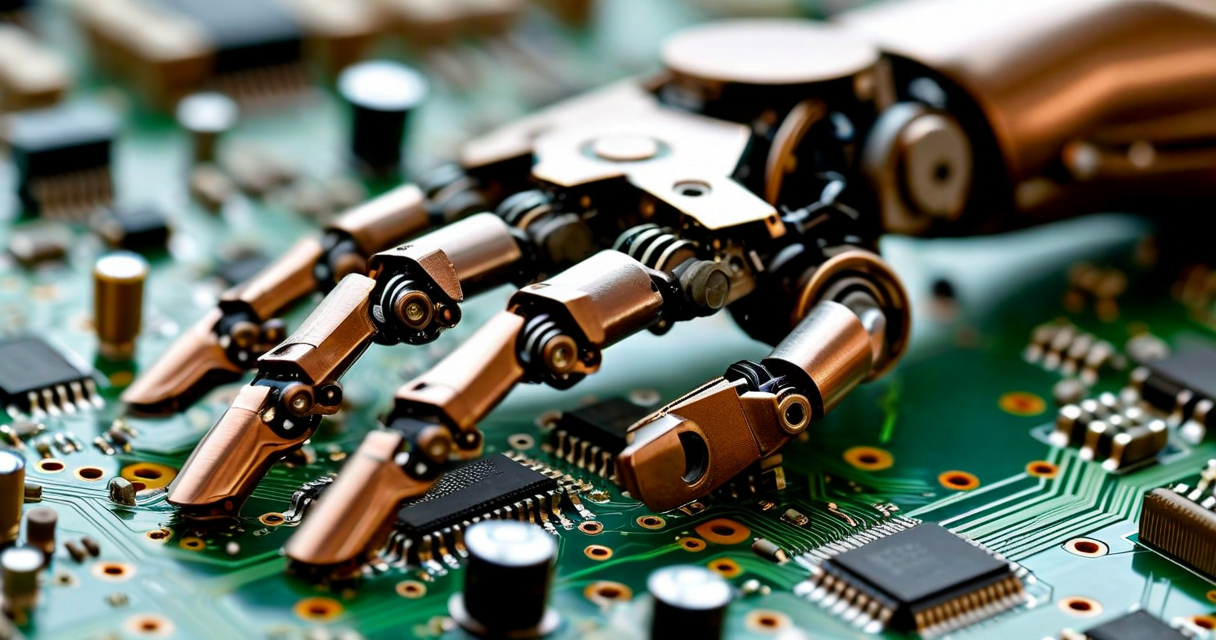
The term "embodied intelligence" has moved from academic robotics literature into venture pitch decks at a remarkable pace. The underlying idea is compelling: rather than confining AI to purely digital domains, embed it in physical systems that can perceive, reason, and act in the real world. A robot that can see, understand language, plan sequences of actions, and execute physical tasks with dexterity is no longer a science fiction concept — it is an active area of intense engineering and significant investment.
At Gravis Robotics Capital, we spend a great deal of time thinking about what embodied intelligence means in practice — where the genuine technical progress lies, where the hype exceeds the reality, and what investment implications flow from an honest assessment of both. This piece is our attempt to share that thinking.
The Perception Revolution: Computer Vision at Scale
The foundation of embodied intelligence is perception. A robot cannot act intelligently on an environment it cannot accurately perceive. For decades, robotic perception relied on structured environments, careful lighting, and explicit programming to recognize specific objects in specific positions. The system worked well within its design parameters and failed catastrophically outside them.
The deep learning revolution transformed this. Convolutional neural networks trained on massive labeled datasets can now identify and localize objects in scenes with a degree of robustness and generalization that classical computer vision systems could never approach. Modern vision systems can handle variations in lighting, scale, viewpoint, and partial occlusion that would have defeated earlier approaches entirely.
More recently, vision foundation models — large models trained on internet-scale image and video data — have demonstrated zero-shot and few-shot generalization that is genuinely remarkable. A model trained on billions of images can recognize novel objects it has never seen in training data, classify them correctly, and estimate their spatial pose, all from a handful of example images. For robotics, this is transformative. It means that the labeling and annotation burden required to deploy a vision system in a new environment drops dramatically.
Practical robotic vision still has significant challenges. Real-time processing latency, reliable performance under motion blur, handling of transparent or reflective objects, and robust performance in outdoor conditions with uncontrolled lighting all remain active engineering problems. But the trajectory is clear, and the rate of progress is accelerating.
Language Models as Robot Brains
Perhaps the most surprising development in embodied AI over the past several years has been the emergence of large language models (LLMs) as a core component of robot control architectures. This might seem counterintuitive — what does text prediction have to do with physical manipulation? The answer lies in the fact that language models are, at their core, powerful reasoning engines that have absorbed enormous amounts of structured knowledge about the world.
Research groups at major universities and technology companies have demonstrated systems where an LLM serves as the "brain" of a robot, translating natural language instructions into sequences of lower-level actions. A human says, "Pick up the red cup and put it in the drawer on the left." The LLM reasons about the spatial layout, identifies the relevant objects, decomposes the task into primitive actions (locate cup, move arm to cup position, grasp, carry, locate drawer, open, deposit, close), and passes those instructions to lower-level control systems that execute them.
This architecture does not require the LLM to have any direct physical knowledge — it leverages the language model's broad world knowledge and reasoning capability, while specialized perception and control modules handle the physical execution. The result is a system with a degree of task flexibility and adaptability to novel instructions that purely programmed systems cannot match.
The limitations are real. LLMs can hallucinate — confidently proposing actions that are physically impossible or dangerously wrong. Real-time response latency from large cloud-deployed models is often too slow for reactive control tasks. Grounding the language model's abstract reasoning in accurate real-world perception remains an open research problem. But the direction is promising, and the pace of progress is extraordinary.
Reinforcement Learning and Simulation: Teaching Robots to Be Dexterous
Dexterous manipulation — the ability to pick up, reorient, and manipulate objects with the kind of fingertip control that humans develop in early childhood — has been one of the hardest problems in robotics. Early industrial robots solved this problem by cheating: they worked in perfectly structured environments, with parts presented in known positions, using purpose-built end effectors for specific tasks. The moment you ask a robot to handle the variety of objects in a typical household or warehouse, the problem becomes dramatically harder.
Reinforcement learning has opened new doors here. By training robotic control policies in high-fidelity physics simulation — where the robot can attempt a task millions of times, fail, receive a reward signal, and gradually improve — researchers have developed manipulation capabilities that far exceed what could be programmed by hand. Critically, modern simulation-to-reality transfer techniques have improved to the point where policies learned in simulation can be deployed to physical hardware with relatively modest fine-tuning.
This has practical investment implications. Companies building proprietary simulation environments, training pipelines, and transfer learning methods for dexterous manipulation are building defensible technical assets. The compute required to run these training workloads is significant, but the resulting learned policies can be deployed on relatively modest physical hardware. The separation of the expensive training process from the deployment cost changes the economics of deploying capable robotic systems at scale.
Humanoid Robots: Real Opportunity or Distraction?
No discussion of embodied AI in 2025 would be complete without addressing humanoid robots. Multiple well-funded companies are developing bipedal humanoid platforms, and the topic has attracted enormous press coverage and venture capital interest. The thesis is straightforward: the world is built for human bodies, so a robot with a human-like form factor can operate in existing facilities without requiring infrastructure modifications.
Our view is nuanced. The long-term thesis is sound. If you can build a humanoid robot that is reliable enough, dexterous enough, and cheap enough, the addressable market is indeed enormous. But the engineering challenges are formidable, and the timelines required to reach genuine commercial viability at scale are long. We are skeptical of near-term financial projections that assume rapid penetration of general-purpose humanoid platforms into industrial environments.
The more interesting near-term opportunity, in our view, lies in purpose-built robotic systems that solve specific, high-value problems with purpose-designed form factors. A robot designed specifically for picking and sorting in an e-commerce fulfillment center can be more reliable, more cost-effective, and commercially deployable sooner than a general-purpose humanoid. We invest across both categories, but our seed-stage capital tends to favor specificity over generality.
What This Means for Investment
The embodied intelligence wave creates investment opportunities across multiple layers of the stack. At the hardware layer, we are watching advances in soft robotics, tactile sensing, and novel actuator designs that will enable new categories of manipulation. At the perception layer, foundation model companies building purpose-designed robotic vision systems represent a compelling opportunity. At the control and intelligence layer, companies building the software stack that translates AI reasoning into reliable physical execution are perhaps the most interesting category of all.
We are particularly excited about companies that are leveraging embodied AI to attack markets where the economics are compelling and the competition from traditional automation is limited. Healthcare, food processing, and precision manufacturing are all categories where the combination of AI-driven flexibility and robotic precision opens markets that rigid programmed systems could never serve.
The technology is real, the markets are large, and the capital gap at the seed stage remains significant. That combination is precisely why we built Gravis Robotics Capital, and it is what drives our investment thesis every day. Learn more about our portfolio companies and reach out if you are building in this space.
Key Takeaways
- Vision foundation models are enabling robotic perception systems with unprecedented generalization to novel objects and environments.
- Large language models are emerging as robot "brains" that translate natural language instructions into action sequences.
- Reinforcement learning in simulation is making dexterous manipulation commercially viable for the first time.
- Humanoid robots represent a long-term opportunity but face significant near-term engineering and timeline challenges.
- The most attractive seed-stage investments combine specific market focus with defensible AI-driven technical differentiation.
Conclusion
Embodied intelligence is not a single technology breakthrough — it is the convergence of advances in perception, reasoning, and physical control that are together transforming what robotic systems can do. The companies that can synthesize these advances into reliable, commercially deployable products are building some of the most exciting and important businesses of this decade. We are committed to being the earliest and most engaged investors in that category. Our $20M Seed Round gives us the resources to back these companies at the moment when the support matters most.